

In Plateau, the official face of Côte d’Ivoire rises toward the sky. Cranes swing above ministerial buildings. New roads cut through the city. Bridges, towers, and construction sites give Abidjan the vocabulary of a country in motion. In the distance, Tour F—the state-backed administrative tower promoted as one of Africa’s tallest buildings—dominates the skyline, a symbol of ambition, power, and vertical modernity. But at street level, another image competes with the skyline.
In parts of Abidjan, rubbish sits stewing in the heat. The smell rises from gutters, market corners, roadside dumping points, and blocked drainage channels. Pedestrians step around plastic bags, food waste, and stagnant water. The same city that asks citizens and investors to look upward also forces residents to look down.

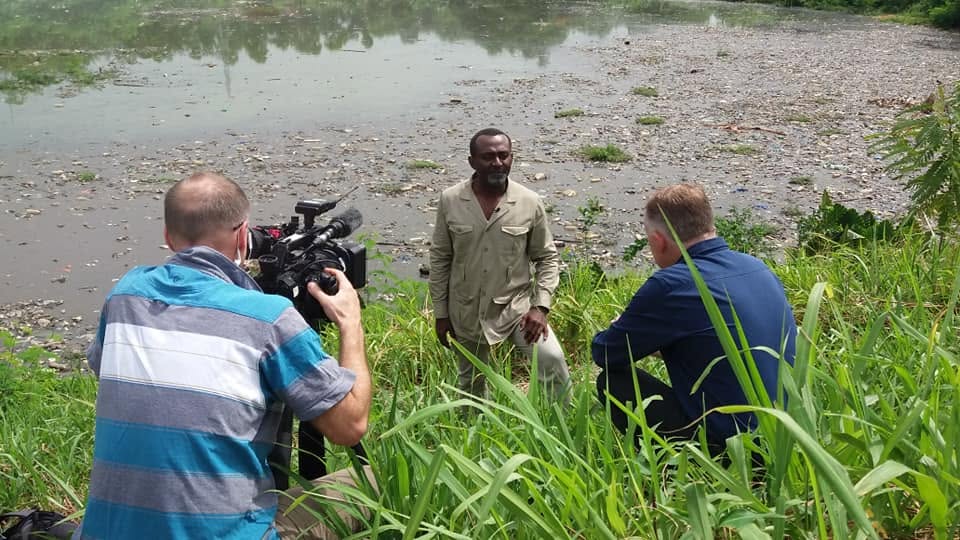
In 2018, while working on an environmental piece with a British television crew, I toured polluted sites in Abidjan and around the country. The current crisis is thus not a sudden discovery; it is the return of a problem the state has promised to solve for years.
That contradiction lies at the heart of Côte d’Ivoire’s emergence narrative. The country has built a reputation as a lender-friendly, pro-Western, infrastructure-driven success story. It is praised for its stability, its strong growth, its role as the world’s leading cocoa producer, and its strategic position along the Gulf of Guinea. Yet Abidjan’s recurring waste crisis reveals a more complicated picture: a state able to build towers and reassure international partners, but still struggling with one of the most basic functions of urban governance—collecting garbage.
Reassurance is not collection
During a televised field visit to the CVET of Kossihouen, the technical landfill and waste-treatment site serving Abidjan, Amédé Koffi Kouakou, Côte d’Ivoire’s minister of hydraulics, sanitation, and salubrity, sought to reassure the public.
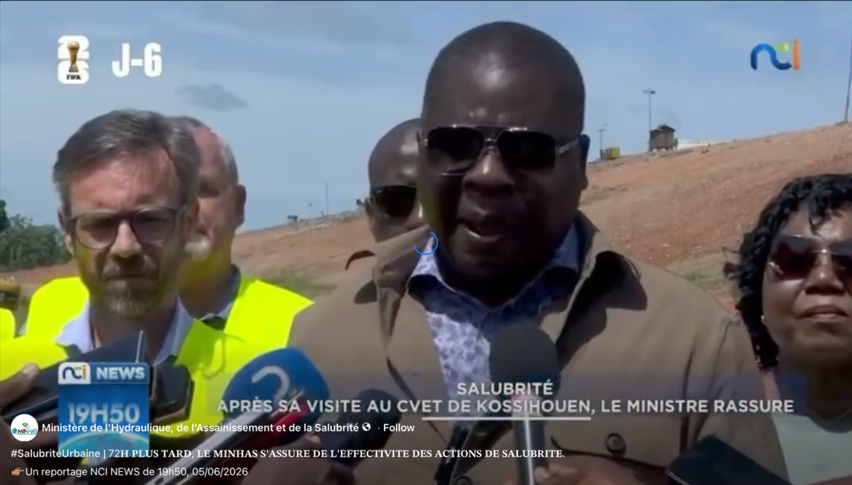
Broadcast on NCI News on June 5, 2026, and later circulated by the ministry, the report carried the headline: “After his visit to the CVET of Kossihouen, the minister reassures.” But the crisis has already moved beyond reassurance.
In a public analysis titled “Household Waste in Abidjan: Toxic Waste or Lasting Gold?”, Dr. Ing. Ahoua Don-Mello—an engineer, former director-general of BNETD, former minister of equipment and sanitation in the Laurent Gbagbo administration, and opposition figure—described Abidjan as an “open-air dump” in the middle of modern infrastructure. He argued that Minister Kouakou’s 72-hour instruction to waste operators to clear the city sounded either like a provocation or a misunderstanding of the depth of the crisis. The deadline passed, he wrote, while the waste continued to accumulate.
Don-Mello’s figures give the crisis a sharper edge. According to his analysis, Abidjan produces nearly 5,000 tons of waste per day, but the average collection rate is only about 54 percent, compared with 86 percent in the rest of the country. Recycling, he said, remains almost nonexistent, at around 1 percent.
If accurate, those numbers change the frame of the debate. The issue is not only that Abidjan produces too much waste. It is that nearly half of the city’s waste may not be properly collected.
Don-Mello also points to the sector’s financial structure. The annual budget of the waste management chain, he estimates, is 40 to 60 billion FCFAs, largely dependent on state subsidies. Furthermore, he points out, ANAGED, the national waste management agency, faces chronic payment delays from the state, limiting its ability to pay private collection operators.
He names two main operators: ECOTI SA, responsible for Sector 1, including Abobo, Anyama, Cocody, Plateau, and Bingerville; and ECO EBURNIE, responsible for Sectors 2 and 3, including Attécoubé, Adjamé, Songon, Yopougon, Koumassi, Port-Bouët, Treichville, and Marcory.
If payment delays have weakened their waste management operations, then the crisis is not simply a matter of citizen behavior, sudden waste growth, or poor civic discipline. It is a breakdown in the financing and contracting chain.
That claim opens a concrete line of inquiry. How much does the state owe ANAGED? How much does ANAGED owe private operators? Which communes are most affected? Are trucks grounded because of unpaid bills, fuel shortages, or maintenance problems? What are the collection targets in each contract? And why has the government not published a clear operational dashboard showing tonnage produced, collected, transferred, and buried?
An old governance problem
Abidjan’s waste crisis did not begin with the current pile-ups.
Academic research has long identified household waste collection as one of the city’s structurally unequal urban services. In a 2009 article in Belgeo, researcher Amandine Henry linked unequal access to waste collection in Abidjan to repeated institutional shifts between centralization, decentralization, and recentralization. Each reform changed the management of household waste but also produced new inequalities between communes and neighborhoods.
For decades, Akouédo embodied that failure. Opened in 1965, the former landfill became a symbol of urban neglect and a public health risk.
In 2018 the state closed Akouédo and shifted toward the CVET of Kossihouen, which was presented as a more modern system for treatment, burial, and waste reclamation. That transition was supposed to mark a turning point.
But modern infrastructure does not automatically produce a modern service.
A sanitation crisis is rarely only about garbage. It is often about contracts, subcontractors, payments, equipment, political influence, oversight, and public procurement. In Abidjan, it also exposes the limits of a service delivery model built on outsourcing without sufficient public control.
Since the structural adjustment conducted in the early 1990s under the current president, a former IMF official, and then prime minister, Côte d’Ivoire’s public services have been increasingly reorganized through austerity measures, the creation of agencies, the introduction of private operators, and the adoption of contract-based delivery. The model was intended to bring efficiency and professionalization. In practice, when oversight is weak, financing is opaque, and payments are delayed, outsourcing can fragment responsibility rather than improve service.
The state retains control over the money chain; private operators depend on public payments; municipalities are stripped of their operational capacity; and citizens are left without clear authority to hold anyone accountable when garbage remains in the street.
That is why Abidjan’s waste crisis is not only logistical. It is institutional—and political.
When rain exposes failed planning
The rainy season turns the waste crisis into a public health threat. It also exposes a deeper weakness in government planning.
As extreme rainfall becomes more disruptive, Abidjan’s sanitation failures become harder to disentangle from the city’s broader urban development model. The problem is not only that garbage is not collected. It is that large parts of the city have expanded without building the drainage, sewer lines, wastewater systems, and basic sanitation infrastructure needed to absorb heavier rains.
The result is unavoidable. Plastic waste blocks drains. Floodwater spreads uncollected rubbish through streets, courtyards, markets, and homes. Stagnant water creates mosquito-breeding sites. Contaminated runoff carries decomposing waste, human waste, and other pollutants through neighborhoods. What begins as a failure of collection escalates into a chain reaction: blocked drainage, flooding, exposure to disease, and public health risks.
This is where the spectacle of construction collides with the reality of planning. Roads, bridges, towers, and new buildings may suggest modernity, but without sewer lines, drainage maintenance, waste collection, and flood preparation, urban expansion becomes fragile. A city cannot build its way into emergence without underground systems, gutters, and sanitation networks.
That link between flooding, sanitation, and health is already recognized in Côte d’Ivoire’s own urban resilience agenda. In 2020 the World Bank approved a $315 million Urban Resilience and Solid Waste Management Project for the country. Its stated objectives included reducing vulnerability to flooding in selected urban areas and improving solid waste management in targeted municipalities. In other words, the problem was already known, financed, and formally linked to urban resilience.
That makes the persistence of visible waste and recurring floods in Abidjan a legitimate accountability issue.
The politics of garbage
The government’s explanation is also being challenged inside Côte d’Ivoire. On June 9, 2026, the Ivorian newspaper Notre Voie led its front page with the headline “Household waste and diseases invade Abidjan,” followed by a direct accusation: “Amédé Kouakou hides the truth from Ivorians.” The paper also pointed to “non-renewed contracts” as a possible factor behind the crisis.
In a separate video statement circulated online, Pascal Affi N’Guessan, leader of an opposition party, framed the crisis as the result of patrimonial governance. Waste collection, he argued, has been removed from local authorities and centralized through ANAGED, leaving municipalities without the resources to manage the service. More pointedly, Affi alleged that the waste management file had been reorganized around someone close to President Alassane Ouattara, linking the crisis to what he described as the capture of public functions by interests connected to those in power.
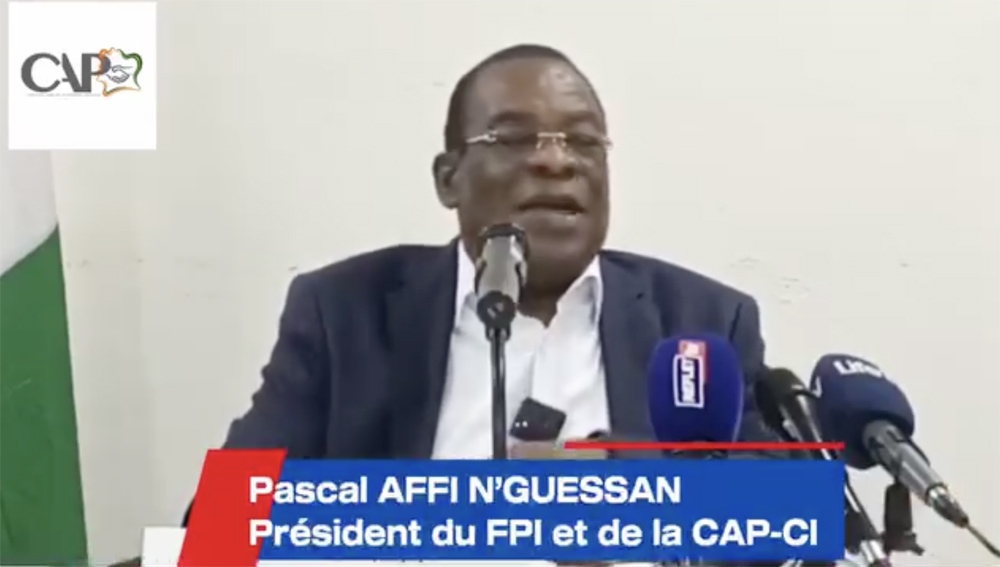
Affi N’Guessan’s comments are political and should be read as opposition criticism. But they reinforce a central question: has the centralization of waste management improved efficiency, or has it concentrated budgets and accountability in a way that makes local failure harder to correct?
The crisis also tests the role of Abou Bamba, Côte d’Ivoire’s recently appointed minister of environment and ecological transition. A former international environmental specialist, Bamba embodies the technocratic promise of ecological transition, circular economy, and waste reclamation. Yet the operational and financial center of the waste file appears to remain with the sanitation portfolio led by Minister Kouakou.
For one political analyst, who asked to be identified only by the initials N.T. because of the sensitivity of the issue, environmental ministries in Côte d’Ivoire are often treated as lower-tier portfolios: useful for showing international partners that the government is environmentally responsible, but not necessarily equipped with the authority or resources to drive hard operational decisions.
That view may be debated. But Abidjan’s streets are now asking a basic question: what is the value of waste valorization theory when waste is still rotting in public space?
The street asks for proof
Abidjan’s garbage crisis leaves Côte d’Ivoire facing uncomfortable questions about its causes. Is it a temporary logistics failure resulting from rapid urban growth and a sudden increase in waste? Is it a structural governance failure rooted in delayed payments, weak planning and poor coordination? Is it a symptom of a deeper political economy that gives priority to large, visible projects while neglecting basic maintenance? Or does it point to a deeper corruption and procurement problem that has not yet been fully documented? The answer may include all four.
Don-Mello proposes an emergency response: pay the arrears, mobilize the military engineering corps to support the operators, and clear the city within a realistic yet urgent timeframe. Longer term, he argues for cleaner financing, waste-to-energy, composting, recycling, source sorting, and industrial reuse.
Though his argument is politically charged, it nonetheless captures the central dilemma: Abidjan’s waste is both a toxic emergency and a potential economic resource. The question is whether the state has the governance capacity to move from crisis management to value creation.
After more than a decade of infrastructure politics, the government can no longer rely solely on the language of emergence. It must show performance. It must show data. It must show contracts. It must show results. Without that evidence, the garbage drama becomes political.
Côte d’Ivoire’s ambiguity is that it can be many things at once: a good borrower, a strategic Western ally, a major supplier of natural resources, a fast-growing economy—and still a country where basic governance remains contested.
And in the shadow of Tour F, Abidjan’s garbage asks the question that no tower can answer: can a government claim sky-scraping modernity if it cannot manage the waste beneath its feet?