
Ghana faces a dilemma: can its two major economic engines—gold mining and cacao farming—coexist?
Gold mining has a long history in Ghana, since colonial times, when it was known as “Gold Coast.” It was enormously important the independent country’s economic development. Today Ghana is Africa’s second largest producer of gold after South Africa. Since 1989 its mining industry has boomed, driven by private sector development.
The Ghanaian government goes all out to support gold mining, providing an attractive environment for large-scale mining companies, to which it has released vast land concessions. In 2024, international gold-mining companies mined about 90 metric tons of gold in Ghana, raising Ghana to the level of sixth-largest producer worldwide.
But what does large-scale corporate mining do for the people of Ghana? Not much. It doesn’t provide man jobs: in 2024, the companies had only 11,300 people on their Ghanaian payrolls, plus a few tens of thousands of contract workers. Meanwhile young people don’t have many job options in the formal economy, unemployment is rampant—and the cost of living is rising.
So many individuals turn to artisanal and small-scale mining, or ASM. To legally mine gold on a small scale they must apply for a license—but the onerous paperwork and high registration fees make it almost impossible to get one. Only about 15 percent of small-scale miners actually possess licenses.
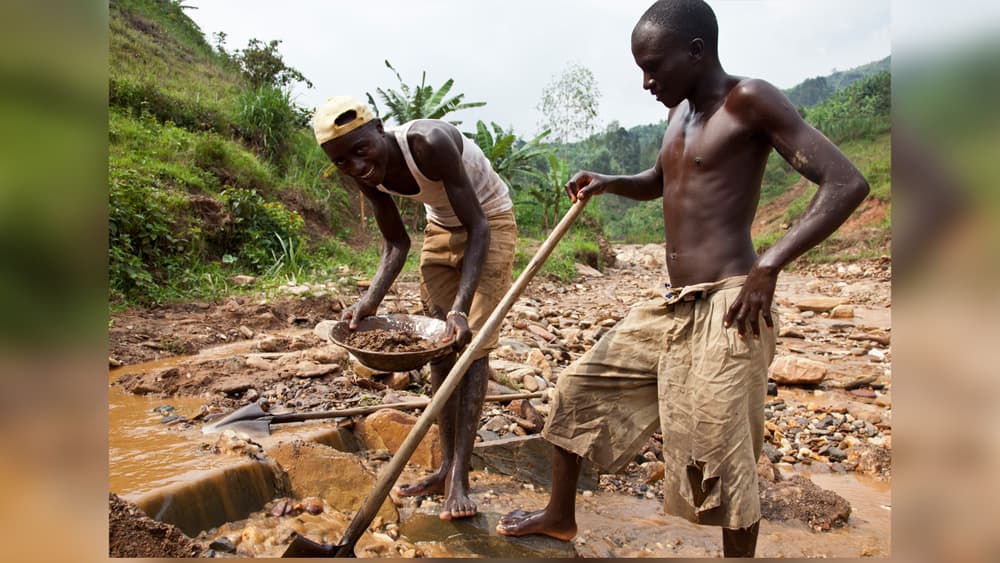
Most of them give up the legal route and mine gold without a license—that is, illegally. Illegal gold mining has its own name: galamsey, meaning “gather them and sell.” In the last two decades, Ghana’s eastern districts have seen a proliferation of unlicensed gold mining. Today, between 1 and 2 million Ghanaians work in galamsey. It’s a viable living—mine workers may earn around US$70 per day.
Cacao Farming Under Duress
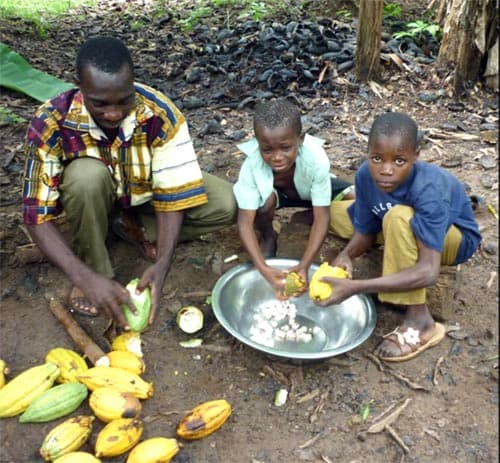
Ghana’s other large economic driver is cacao farming. An estimated 6 million Ghanaians engage in cacao production, mostly on small farms of 2 to 4 hectares each. The plots are small, but the aggregate is huge. Today Ghana is the world’s second-largest cacao producer, after Côte d’Ivoire, contributing up to 1 million metric tons annually. And cacao is one of Ghana’s top foreign exchange earners.
But Ghanaian cacao production is falling on hard times. Production is slumping, falling from more than 1 million metric tons in 2020–21 to just under 600,000 in 2025–26.
Why? For several reasons. First, it’s not easy for small farmers to earn a viable living, The government chronically underinvests in cacao farming, especially since structural adjustment programs abolished basic subsidies for agriculture.
Second, a lethal virus called Swollen Shoot has been infecting cacao trees and kills them within five years. It’s endemic to all of Ghana’s cacao-growing areas, affecting up to 80 percent of trees. There is as yet no cure.
And finally climate causes problems. Cacao is highly sensitive to temperature and water conditions and does not flourish amid higher temperatures, erratic rainfall, and periods of excessive rain and drought. Moreover, cacao trees, which are small, thrive in the shade of larger tres, so they need a forest-like microclimate. Deforestation further exposes cacao to the stresses of high temperatures and drought.
But of all these assaults unleashed on Ghanaian cacao production, the most severe is gold mining, or rather galamsey, the unregulated, unlicensed, illegal gold mining that is so widespread today.
But coincidentally—and tragically—Ghana’s largest gold deposits are located in the very places where cacao trees grow best. The forest lands of the Ashanti and Brong, and the Western, Central, and Eastern regions, have been the heartland of cacao farming for generations. But the gold-bearing rocks sought by both small- and large-scale miners are also abundant here.
Mining operators, in their eternal quest for new sources of gold, know that cacao farmers are distress, even despair, and offer to buy their land. To a farmer who can barely sustain a livelihood, the prospect of an immediate lump sum may be highly persuasive. They may even view it as a lifeline. They accept the offer—and in so doing surrender the land that once sustained their families and their ancestors.
If a farmer is unwilling to sell, mining operators may use pressure. They may flood a neighboring farm with contaminated water, rendering the land useless for farming and leaving the landowner no option but to sell.
Sometimes cacao farmers themselves, faced with insufficient income, may choose to switch their land use from farming to galamsey.
Effects of Galamsey on Farmland
Once a mining operator secures a piece of cacao farmland, they set to work. They burn the cacao trees, or they dump chemicals on the land to kill them. They bring in mechanical diggers to clear the dead trees. They sink diesel pumps into the nearby river, which power the high-pressure hoses that they use blast the soil. The water blasts turn the soil into slurry, which is channeled downhill to a washing station on the riverbank.
Over the course of the next months, the miners pass every grain of soil from the old cacao farmland through this washing station. So intense is the washing process that it flushes away all organic material. It breaks the soil into particles, separating out the gold. Mercury is then added to the gold residue to bind it, allowing everything else to be washed away. The final product, at the end of the day, is a few small pellets of gold.
The worker earns some cash, but a onetime forested cacao orchard, where trees plunge their roots into rich dark soil, has become a barren desert of white sand heaps and craters, interspersed with pools of stagnant acid-green water. Nothing further can grow there, not even grass. The land can’t be returned to farming. Galamsey is not merely an alternative livelihood to cacao farming—it is the destruction of cacao farming.
Downstream Contamination
Galamsey also has destructive effects on the environment. Most of those washing stations empty directly into rivers, carrying sediment that suffocates the river’s ecosystem, blocking light and clogging fish gills
The mercury that was used to bind the gold in the washing stations also flows downstream and enters the ecosystem. Small organisms absorb it, and fish consume them, and bird eat the fish, leading to reproductive failure. Plants absorb mercury too—it damages their roots and stems and inhibits photosynthesis. Fish, cassava, plantain, maize—these are Ghanaians’ staple foods, and they may well contain mercury. In humans, chronic mercury exposure can damage nerves and kidneys, and even tiny amounts can stunt brain development in fetuses and infants.
Today mercury pollution has reached crisis proportions in Ghana. Most water sources are contaminated. The national water company can no longer process it and in 2024 cut the water supply for drinking and irrigation by up to 75 percent. “Astonishingly,” observes Maryam Aslany, author of Peasants, “for a country endowed with the grandest river basin in West Africa—the Volta River, which was dammed to create Lake Volta, one of the largest artificial lakes in the world—Ghana is in danger of running out of uncontaminated water. According to one NGO, it will be forced to import fresh water by 2030 if current trends continue.”
Profiting from Disaster
Mercury pollution is also a problem in large corporate mining, but those companies must theoretically adhere to strict environmental regulations, especially regarding clean-up. But galamsey is unlicensed. The contracts that small-scale miners make with farmers, the felling of trees, and the injection of contaminants into land and soil are all outside the law. Yet galamsey accounts for 40 percent of Ghana’s annual gold production—some 60 metric tons, or $8 billion at 2026 rates.
Why don’t the authorities put a stop to galamsey? Why don’t the police raid the site and arrest the miners? One reason is that the people who are supposed to prevent illegal gold mining seem more interested in profiting from it. A 2023 a former environment minister reported that when plans were made to raid illegal miners, a prominent businessman, and relative of the president used his political influence to interfere. In 2024, accusations were raised that revenues from illegal mining were funding the ruling party, and the government fell. The incoming president has promised to give priority to cracking down on galamsey.
Solutions
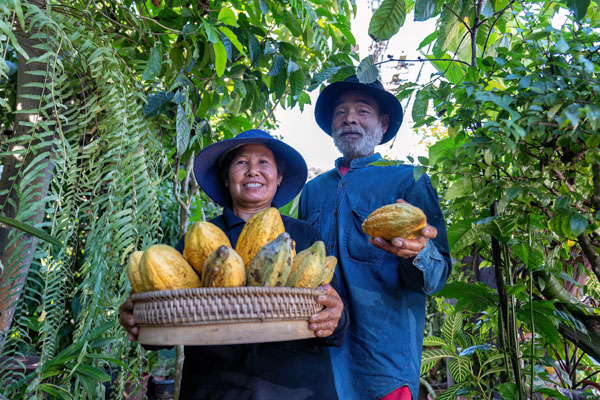
“If there is gold under the land, it will win,” a cacao farmer told author Maryam Aslany. But if gold wins, then Ghana will be doomed to import fresh water. The alternative is for Ghana to refuse to let gold win, and to put long-term sustainability over short-term gain.
Galamsey produces short term windfalls, but cacao trees produce for up to fifty years. Galamsey benefits indivdiuals, but agriculture has a high social term. Galamsey injects poison into the environment, but cacao farming does not. So cacao farming is by far the better long-term investment.
Solving the problems caused by galamsey therefore requires saving cacao farming. The government must step in and finally give cacao farming the investment it has long needed, so that it is once again a viable livelihood. It will have to subsidize farmers. It will have to manage and contain Swollen Shoot disease. And it must provide the public infrastructure necessary for farming, including roads, research, extension services, water and power supplies, storage, and irrigation.
The government, the mining regulatory institutions, and the mine operators should finance the reclamation of mine-degraded lands and remediate the destruction caused by ASM, to restore land to productive use.
Mining is not in itself bad, but the government should bring it under regulation. It must reduce the licensing fees for small-scale mining, and ease other burdensome procedures, so that artisanal gold miners may gain licenses and so be subject to regulation. Both small-scale and large-scale mining must cease using mercury and other poisons in their processes. Finally, government should run educational programs to encourage young people to go into farming and to care for farmlands that are their ancestral legacy.
Sources
Aslany, Maryam. Peasants: Makers of the Modern World. Bloomsbury, 2026.
Boateng, Dennis Owusu, Francis Nana Yaw Codjoe, and Johnson Ofori. “Impact of Illegal Small Scale Mining (Galamsey) on Cocoa Production in Atiwa District of Ghana.” International Journal of Advance Agricultural Research (2014): 289–99.
Dankwah, Daniel Bookye, et al. “Interface between artisanal and small-scale mining and cocoa farming in the Wassa Amenfi East and West Districts of Ghana.” Extractive Industries and Society 17 (March 2024).
Shaw, Daniel, George Ofosu, and David Sarpong. “Cocoa Production, Farmlands, and the Galamsey: Examining Current and Emerging Trends in the ASM-Agriculture Nexus.” Journal of Rural Studies 101 (2023): 103044.
Montford, Josephine, et al. “Converting Cocoa Farms into Gold Mines—Negotiations, Compensation and Outcomes for Farmers in Ghana.” Resources Policy (February 2026).
Photos from Envato Elements.