
“You cannot publish this,” she whispered to me in 2018. “If you do, they will cut off our access to the plantations.” She pointed to a sheaf of medical records that showed an unusual increase in leukemia and brain tumors among children in Côte d’Ivoire’s cacao-growing regions. The director of an Ivorian NGO fighting childhood cancer, she gave me that warning to me eight years ago, and her words said it all. To this day she insists on anonymity.
The subject was explosive then, as it still is now. First Lady Dominique Ouattara had emerged as the leading figure in the fight against child labor. But raising the issue of pesticides in cacao growing would cause problems for an industry vital to the country. Back in 2004 the journalist André Kieffer had disappeared while investigating the coffee and cacao sector, and his memory hung heavily over the issue.
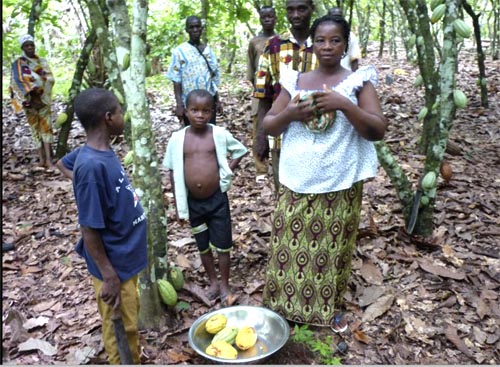
Eight Years Later, Almost Nothing Has Changed
Today the corridors of the pediatric oncology department at Treichville University Hospital remain crowded. The World Health Organization and the International Agency for Research on Cancer estimated that Côte d’Ivoire had 876 new cases of childhood cancer in 2020. The country’s National Cancer Control Program estimates records nearly one thousand new cases every year.
Internal hospital data indicate approximately 600 child patients died in 2022—more than one in two. “Most of our patients come from the Center-West and Southwest, the heartlands of cacao production,” says a physician who requested anonymity.
Interviewed by the Ivorian Press Agency, Innocent Adoubi, coordinator of the National Cancer Control Program, acknowledged that a large number of sick children come from rural areas. “We do not yet have a precise mapping of this situation,” he qualified, “but we are working on it.”
A precise map could prove to be most troubling.
The Chemical “Kalashnikov”
On farms in Daloa, Soubré, Méagui, and Duékoué, backpack sprayers are part of the landscape, applying glyphosate, 2,4-D, paraquat, and triazole fungicides. Since Côte d’Ivoire’s push for pest and weed control began in 2008, chemicals have become deeply embedded in plantation agriculture.
As an herbicide, glyphosate—marketed as Roundup—is so effective that farmers here have nicknamed it “Kalashnikov.” It has a reputation for mowing down weeds in a single shot.
The products that the government recommends are not necessarily harmless, and it exercises only limited control over how farmers actually use them.
Smallholder farmers, who make up the majority of producers, face intense pressure to increase yields. Plagued by inadequate income, many turn to cheaper, obsolete, or smuggled pesticides whose components may have escaped close oversight. These products expose farmers and children to serious health risks while contaminating the very soils, waterways, and ecosystems upon which cacao productivity depends.
“The proper chemicals are expensive. Smuggled products allow us to preserve an increasingly thin profit margin,” says K.T., a cacao farmer in the Southwest.
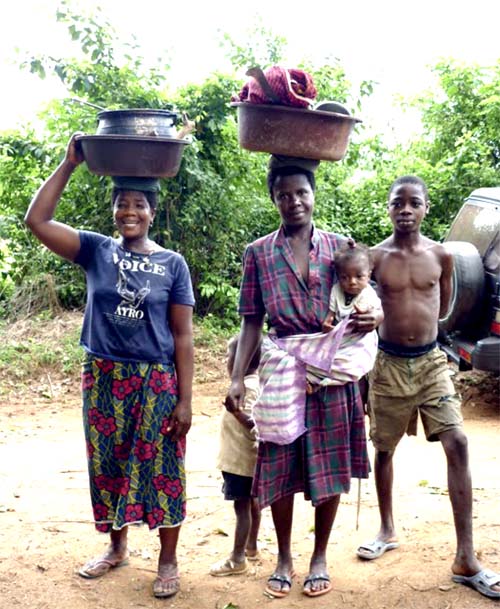
Most disturbing is the frequent delegation of spraying to women. Some are pregnant, while others carry infants even as they handle these hazardous products without adequate protective gear. So children can be exposed in the womb and again during their first months of life.
A study conducted by NORC at the University of Chicago, published in 2020, found that 24 percent of children surveyed had handled agrochemicals or been in the vicinity of pesticide spraying—four times the proportion recorded in 2009.
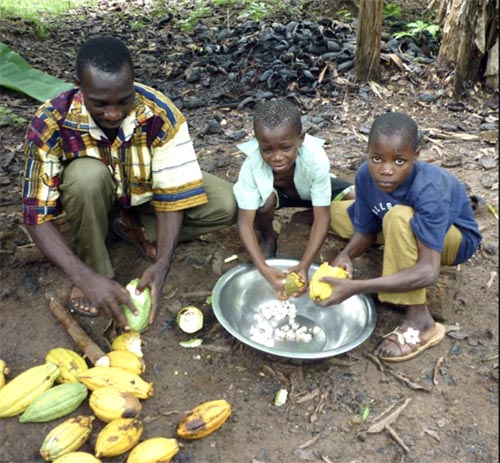
Pesticides and Child Labor: The Double Silence
The government says that since 2012 it has removed more than 80,000 minors from plantations, yet child labor persists. Even as multinational chocolate companies promote their traceability programs, children continue to live and work in environments where they may be exposed to agricultural chemicals.
Two meta-analyses published in 2021 and 2022 associate household or agricultural pesticide exposure with an increased risk of acute lymphoblastic leukemia and brain tumors in children.
In March 2025, a study examining 2,500 pediatric cases in Nebraska reported a 36 percent increase in brain cancers and a 23 percent increase in leukemia in areas where glyphosate, dicamba, and paraquat were used together.
Côte d’Ivoire still lacks an epidemiological study that could establish what is actually happening in its cacao-growing regions. The absence of evidence thus becomes a safe refuge for those who are unwilling to look for it.
Who Is Protecting Whom?
In 2011, Côte d’Ivoire’s cacao sector was under intense international pressure. That November Ivorian first lady Dominique Ouattara was appointed president of the National Monitoring Committee for Actions to Combat Trafficking, Exploitation and Child Labor. In 2012, supported by the Children of Africa Foundation and several partners, she launched a campaign against child labor.
The monitoring committee’s official communications focused only on issues of trafficking, exploitation, and school attendance. They made no mention of children’s exposure to pesticides .
The committee protects children—at least on paper—from these abuses of their labor. But who protects them from chemicals they breathe, touch, and even carry back into their homes?
Alleged Conflicts of Interest
The activities of Loïc Folloroux, the First Lady’s son, have raised questions about the proximity between political power and commercial interests. Folloroux founded Africa Sourcing, a major exporter of Ivorian cacao.
He had previously held senior responsibilities at Armajaro Trading Group, a commodities trading giant that speculated on cacao to the country’s detriment, including during the period of armed rebellion that preceded Ouattara’s rise to power.
In 2015, Sucden, the French-based commodity broker, was excluded from the list of approved cacao exporters. Reuters reported that within the industry, the exclusion was perceived as a possible “political signal” following a dispute with Africa Sourcing.
Africa Sourcing’s proximity to the presidential camp, some analysts warn, complicates efforts to confront the pesticide issue. “You cannot be both judge and interested party,” argues Pierre D., a specialist in organic agriculture.
Numbers Raise Questions
Côte d’Ivoire exported approximately 1.8 million metric tons of cacao during the 2024–25 season. According to figures attributed to the Coffee-Cacao Council, more than 90 percent of plantations are reportedly treated with pesticides at least three times a year.
The country’s pesticide imports have risen sharply, from 7,000 metric tons in 2008 to approximately 25,000 in 2024—an increase of nearly 260 percent, according to foreign-trade data and industry reports.
The World Bank estimated in 2022 that approximately 40 percent of agricultural inputs circulated outside formal distribution channels. A study by the human rights organizations INKOTA and Südwind found that 96 percent of the pesticide containers they observed were abandoned, discarded, or burned on site.
In 2023, LANADA, an Ivorian government institution that supports agriculture, reportedly found elevated concentrations of cadmium in some batches of cacao beans. This concern is now compounded by illegal gold mining, as mercury and other pollutants contaminate waterways and agricultural soils amid troubling public health indifference.
What Must Be Done
The Ivorian government should begin phasing out the most hazardous pesticides by 2027, including paraquat, dicamba, 2,4-D, and other substances that pose serious risks to workers and children.
It should establish regional cancer registries, publish geographical data on cases, subsidize protective equipment, and provide farmer training in local languages. A share of cacao revenues should finance pediatric oncology units and maternal and child health programs in cacao-producing regions.
It must also strengthen agricultural inspection and impose meaningful penalties for child labor, illegal pesticide sales, and violations of phytosanitary regulations.
As for chocolate multinationals, they must move beyond cosmetic messaging about sustainability. They should finance a living income for producers; mount independent audits of chemical residues and child presence on farms; and transition to agroforestry, shade-grown systems, biological pest control, and crop diversification.
They should also disclose their suppliers, cooperatives, and purchasing volumes. A company cannot credibly claim to guarantee sustainable cacao while keeping in the shadows both the people who produce it and the chemicals they use.
A Cacao Farmer’s Wish
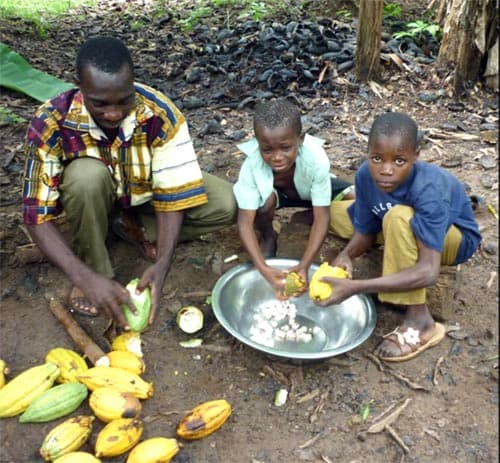
At dusk, in a cacao grove in Méagui, K.T. puts away his sprayer. His six-year-old daughter clings to his leg, curious about the acrid smell still hanging in the air.
“I want her to go to school, not to the hospital,” he murmurs.
In Abidjan, the whistleblower still keeps her medical files. She is waiting for the day when the numbers will speak louder than the slogans.
But numbers do not speak on their own. Someone must be willing to invoke them. Until they do, every square of chocolate will carry traces of a silence that producers, authorities, and industry are asking all of us to share.
Photos by Tom Neuhaus.